

Analóg Angelika: E táj – válogatott képek választott hazámról
Tisztelt Hölgyeim és Uraim, Kedves Barátaink, Kedves Angelika!
A tájkép az a műfaj, amelyről már legalább kétszáz éve rendszeresen kijelentjük, hogy „meghalt”. Aztán minden nemzedékben kiderül, hogy mégis él, virul, makacsul ellenáll a temetéseknek, mint egy jó balatoni nádas, amit hiába vágnak ki tavasszal, nyárra újra ott hullámzik. Jó, lehet, hogy e hasonlat helyet másikat kéne keresnem. Szóval olyan, mint a balatoni nádas volt a betonozás előtt.
A tájkép ellen azonban még nem találtak ki betont: egyszerűen túléli a korszakokat. Túléli az akadémiákat, a forradalmakat, az izmusokat, a filtereket és az Instagramot is. Sőt: amikor már mindent lefotóztunk, akkor még inkább vágyunk arra, hogy valaki végre ne fotózza, hanem lássa is a világot helyettünk.
És pontosan ez történik itt, ma, ezen a kiállításon. Analóg Angelika természeti és városi tájképeket fest. Budapestet, Pécset, a Balatont. Ez első hallásra akár turistaprogram is lehetne: itt egy torony, ott egy rakpart, amott egy domb, és ha elfáradunk, irány a Balaton.
Csakhogy ezek a képek nagyon gyorsan elárulják: itt nem kirándulás történik, hanem emlékezés. Nem városnézés és természetjárás, hanem város- és természetfigyelés. Nem prospektus, hanem vallomás.
Angelika különleges szemszögből nézi ezeket a tájakat és városokat, szóval, ezt az országot. Moszkvában született, Budapesten nőtt fel. Orosz, aki magyarrá vált – vagy ha pontosabbak akarunk lenni: benne is áll a magyar valóságban, de képes kívülről is nézni azt.
Ő maga mondta egyszer nagyon szépen – és nagyon ironikusan –, hogy hivatalosan moszkvai, de nem hivatalosan budapesti. Ez körülbelül olyan, mint amikor az ember azt mondja: „másmilyen az útlevelem, de már itt adózom.” Ha megnézzük ezeket a képeket, nem lehet kétségünk benne, hogy Angelika lelke mindenestül itt adózik.
És ez különösen fontos most, amikor annyi szó esik identitásról, hovatartozásról, zászlókról, határokról. Angelika képei nagyon diszkréten azt mondják: a haza nem útlevélkérdés, hanem emlékkérdés.
Nézzük csak meg ezeket a városképeket! Ezeken a képeken Budapest sokszor kék. Néha zöld. Néha rózsaszín. Néha egészen sötét. A Parlament, a hidak, a rakpart nem úgy néznek ki, ahogyan a Google Mapsen. Hanem úgy, ahogyan bennünk élnek egy fáradt nap végén, egy esős délutánon, egy túl hosszú gondolat után.
Ezek nem pontos látképek. De pontos emlékképek. Ha Angelika Budapestről fest, nem azt kérdezi: „Hány méter magas ez a torony?” Hanem azt: „Milyen volt először meglátni?” „Milyen volt elmenni mellette?” „Milyen volt nem figyelni rá, majd egyszer csak újra észrevenni?”
Van egy mélyen emberi történet is a képek mögött. Angelika sokáig nem akart festő lenni. Rajzolt, tanult, marketinggel foglalkozott, aztán csodálatosan szatirikus rajzokat készített, karikatúrákat – szóval olyan dolgokat, amelyekhez emberek kellenek, zaj, mondatok, helyzetek, beszólások.
Aztán megszülettek ezek a képek, amelyeken nincsenek emberek. És az emberekkel együtt eltűntek a mondatok is. És akkor történt valami nagyon fontos: a táj kezdett beszélni helyettük. A város vagy a balatoni táj lépett be a műterembe. A házak és a hidak. A dombok. A víz. Az ég. És kiderült, hogy ezek is tudnak történeteket mesélni. Csak sokkal csendesebben.
Hadd legyek kicsit személyes: engem e kiállítás mindhárom témájához erős kötelék fűz. Tősgyökeres budapesti, sőt, pesti vagyok, de éveket éltem Pécsett is, és ha már nem bírom elviselni imádott szülővárosomat, rendszeres menedékem a Balaton-felvidék. Angelika, ha nem is tud róla, az én emlékeimet is festi.
A Balaton külön fejezet Angelikánál – és külön fejezet mindannyiunk életében is. Ha valaki magyar, szinte kötelező érvényű gyermekkori élményként rendelkezik legalább egy rossz gumimatraccal, egy leégett vállal, egy papírtálcáról evett hekk-kel és egy olyan naplementével, amelyről azóta is meg van győződve, hogy „az volt élete legszebb naplementéje”.
Angelika Balatonja nem a hekkes-napolajos Balaton. Nem a zajos-turistás-reklámos Balaton. De nem is a naplementés-romantikus Balaton. Hanem a hiány Balatonja. Azé a Balatoné, amely nem mindig csillog, nem mindig nyaral, nem is mindig boldog – de mindig jelen van, az identitásunk része.
És talán ezért olyan erősek ezek a képek: mert nem a boldogságot festik, hanem a ragaszkodást.
Vagy ott van Pécs, a tévétoronnyal. Minden városnak van egy tornya, amelyhez az ember úgy viszonyul, mint egy kicsit kehes nagybácsihoz: nem túl szép, nem túl elegáns, de ha eltűnne, azonnal hiányozna. Angelika ezt a pécsi tornyot pontosan így festi meg: nem ikonként, hanem ismerősként.
Budai vár esőben. Mert miért mindig napsütésben kellene látni? Miért ne láthatnánk úgy, ahogyan legtöbbször tényleg látjuk: kicsit vizesen, kicsit szürkén, kicsit elmosódva? Ráadásul Angelika valószínűleg egy fontos pillanatot kapott el. A Vár, amint sorsára vár az átépítés előtt olyan, mint egy jobb sorsra érdemes oligarcha-feleség, aki – mielőtt akarata ellenére szájfeltöltésre és mellnagyobbításra vinnék – még egyszer belenéz a tükörbe.
A Kiscelli Múzeum lentről, nyáron – amikor az ember vagy felfelé néz, vagy árnyékot keres, vagy mindkettőt egyszerre. Ezek mind olyan nézőpontok, amelyeket nem a turistabuszról lát az ember. Ezek lakónézőpontok.
És most beszéljünk egy pillanatra Angelika Budapest-szereleméről. Ő maga mondta egy interjúban, hogy sokáig nem is foglalkoztatta a város. Túl közel volt. Túl nyilvánvaló volt. Aztán egyszer csak rácsodálkozott. És azóta festi.
Ez is nagyon emberi történet. A legfontosabb dolgokra mindig későn csodálkozunk rá: a városra, ahol élünk, a tájra, amely naponta körülvesz minket, vagy az emberre, aki mellettünk van. Angelika képei egy kicsit azt is megkérdezik tőlünk: „Te mikor néztél rá utoljára igazán arra a környékre, ahol laksz?”
Ha azt mondom, ezek a képek lokálpatrióta képek, nem mondok túl meglepőt. De ha azt is mondom, hogy aki lokálpatriótaként tud nézni a városára, sőt, egy másik városra és egy másik tájra – az bizony patrióta is. És itt érkezünk meg ahhoz a szóhoz, amelytől a legtöbben ösztönösen hátralépnek egy kicsit: ez pedig a hazaszeretet. Elhasznált szó. Túl sokszor mondják túl hangosan. Túl sok zászló mellé teszik oda. Túl sok feltartott ujjú szónok kiabálja el, miközben a hétköznapokban nem nagyon törődik vele senki.
Angelika képei nem beszélnek hazaszeretetről. Egyszerűen csak léteznek vele együtt.
Nem mondják a nézőnek, hogy „szeresd ezt az országot”. Azt főleg nem, hogy legyél rá büszke is. Csak megmutatják, hogy lehet szeretni úgy is, hogy közben nem kell kiabálni. Nem kell bizonygatni. Nem kell versenyre kelni mások szeretetével.
Elég, ha tudjuk, hogy melyik hídon milyen a szél. Elég, ha felismerjük egy város szagát eső után. És elég egy tó színe ahhoz, hogy eszünkbe jusson egy egész nyár. Ez nem politika. Ez emlékezet.
Különösen fontos számomra, hogy Angelika nem „magyarként” fest Magyarországról, hanem emberként fest egy helyről, amely az otthona lett. Ebben van valami nagyon tiszta és nagyon felszabadító. Azt mondja: nem kell ide születni ahhoz, hogy ide tartozzunk. Elég, ha elég sokszor fáztunk itt. Elég, ha elég sokszor szerettünk itt. Elég, ha elég sokszor hittük azt, hogy most már tényleg elmegyünk – és mégsem mentünk.
Számomra ezek a képek ezért fontosak. Mert nem azt mutatják meg, milyen Magyarország. Hanem azt, hogy milyen lehet Magyarország valakinek.
És talán pont erre van most a legnagyobb szükségünk. Nem harsány képekre és még harsányabb mondatokra. Hanem sok-sok személyes nézőpontra. Mert egy ország nem attól élhető, hogy mindenki ugyanúgy gondolkodik róla, hanem attól, hogy sokféleképpen lehet benne élni.
Ezek a képek egyszerre szólnak városokról, tájakról és rólunk. Azokról az apró, nagyon személyes kötődésekről, amelyeket nem lehet rendeletben szabályozni, nem lehet kampányban előállítani, nem lehet plakátra nyomtatni – csak megélni lehet őket.
Analóg Angelika ezeket a megélt kötődéseket festette meg. Budapesttel. Péccsel. A Balatonnal. Ennél sokkal többet nem is tehet egy festő.
A kiállítást ezennel megnyitom.”
Nyáry Krisztián
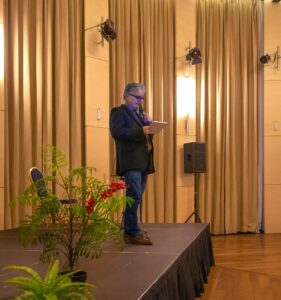
Here is Krisztián Nyáry’s Opening Speech for Angelika Analog’s vernissage of E táj-válagott képek választott hazámról/ A selection of pictures of my chosen homeland in English.
Ladies and Gentlemen,
Dear Friends, and Dear Angelika!
Landscape painting is a genre that we have declared “dead” for at least two hundred years. Then, in every generation, it turns out that it is still alive and kicking, stubbornly resisting its burial, like the reed beds of Lake Balaton, which are cut down in spring only to grow back again by summer. Okay, maybe I should find another analogy. So, the genre is like the Lake Balaton reeds beds before they were concreted over.
However, no one has yet invented concrete for landscape paintings: it simply survives the ages. It survives academies, revolutions, strongmen, filters, and even Instagram. What’s more, once we’ve photographed everything, we tend to long for people to finally not just photograph the world even more, but rather, to help us see it.
And that is exactly what is going on here today at this opening. Angelika Analog paints natural and urban landscapes. Budapest, Pécs, and Lake Balaton. At first glance, this could be a tourist program: here’s a tower, there’s a quay, there’s a hill over there, and when we get tired of these, we head down to Lake Balaton.
But these pictures quickly disclose that this is not an excursion, but reminiscing. Not sightseeing and nature walking, but city and nature observation. It isn’t a brochure, but a confession.
Angelika sees these landscapes and cityscapes, and indeed this country, from a unique perspective. She was born in Moscow and grew up in Budapest. She is a Russian who became a Hungarian – or to be more precise, she is part of the Hungarian reality but is also able to observe it from the outside.
She once very eloquently said – and a bit ironically by the way – that she is officially from Moscow, but unofficially from Budapest. It’s kind of like when someone says, “My passport is different, but I pay my taxes here”. Looking at these paintings, there is no doubt that Angelika’s soul, en bloc, pays its taxes here.
And this is especially important nowadays, when there is so much talk about identity, belonging, flags, and borders. Angelika’s paintings very discreetly suggest that home is not a matter of passports, but rather, of memories.
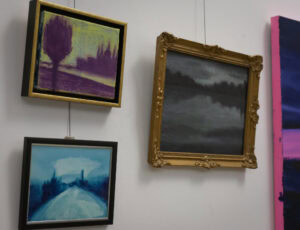
Let’s just take a look at these cityscapes! In these paintings, Budapest is often depicted in blue. Sometimes in green. Sometimes in pink. Sometimes, it is quite dark. The Parliament, the bridges, the riverbank don’t look like they do on Google Maps. Instead, they look the way we see them at the end of an exhausting day, on a rainy afternoon, or after too long a thought has escaped us.
These are not exact representations. But these are accurate memories. When Angelika paints Budapest, she doesn’t ask, “How many meters high is this tower?” But rather, “What was it like to see it for the first time?” “What was it like to walk past it?” “What was it like to not pay attention to it, and then suddenly notice it again?”
There is also a deep human story behind the images. For a long time, Angelika did not want to be a painter. She drew, studied, worked in marketing, and then created wonderfully satirical drawings and caricatures that require people, noise, sentences, situations, and witty remarks or comebacks.
Then these paintings were born, in which there are no people. And along with the people, the sentences also disappeared. And then something particularly important happened: the landscapes began to speak for them. The cityscapes or Lake Balaton landscape entered the studio. The houses and bridges. The hills. The water. The sky. And it turns out that they can tell stories too. Just much more quietly.
I would like to take a moment to share a personal story now if you don’t mind. I have a strong connection to all of the three themes at this exhibition. I am a native of Budapest, or rather Pest, born and bred, but I also lived in Pécs for years, and when I can no longer bear my beloved hometown, I regularly seek refuge in the Balaton Highlands. Angelika, even though she doesn’t know it yet, paints my memories as well.
Lake Balaton is a separate chapter in Angelika’s life – and in all of our lives. If you are Hungarian, it is almost mandatory to have at least one childhood story regarding either a bad inflatable raft, a sunburned shoulder, fried hake eaten on a paper tray, or a certain sunset that we are still convinced was “the most beautiful sunset we’ve ever seen”.
Angelika’s Lake Balaton is not the Lake Balaton of fish and sunbathing oil. It is not the noisy, touristy, advertised Lake Balaton. Nor is it the romantic Lake Balaton of sunsets. It is the Lake Balaton of absence. The Balaton that isn’t always bright and sunny, isn’t always on holiday, isn’t always happy—but it is always present, and it is part of our identity.
And perhaps that’s why these images are so powerful: because they don’t paint happiness, but attachment.
Or there is Pécs, with its TV tower. Every city has a tower that people relate to like a slightly winded uncle: not too handsome, not too elegant, but if he disappeared one day, he would be dearly missed. Angelika paints the TV tower in Pécs exactly the same way: not as an icon, but as a dear friend.
The Buda Castle in the rain. Why should we always see it in sunshine anyway? Why shouldn’t we see it as we usually do: a little wet, a little gray, a little blurry? What’s more, Angelika probably captured it at an important moment. The Castle, awaiting its fate before its reconstruction, like an oligarch’s wife who deserves a better life being taken against her will to have some more work done, who—before having lip fillers and breast augmentation surgery —takes one last look in the mirror.
The Kiscelli Museum from below, in the summer – when you either look up, or look for shade, or both at once. These are all perspectives that you don’t see from a tourist bus. These are a local’s perspectives.
And now let’s talk for a moment about Angelika’s love for Budapest. She herself said in an interview that for a long time she was not interested in the city. It was too close. It was too obvious. Then one day she was amazed. And she has been painting it ever since.
This is also a very human story. We always marvel at the most important things too late: the city where we live, the landscape that surrounds us every day, or the people who are the closest to us. Angelika’s paintings also ask us: “When was the last time you really looked at the neighborhood where you live?”
If I say that these pictures are images of local patriotism, I am not stating anything particularly surprising. But if I also say that anyone who can look at their city, or even another city and another landscape, with local patriotism, they are indeed a patriot. And this brings us to the word that most people instinctively shy away from a little: patriotism. It’s a worn-out word. It’s been used too often, too loudly. It’s placed next to too many flags. Too many finger-wagging orators shout it out, while in everyday life no one really cares about it.
Angelika’s images do not speak of patriotism. They simply exist alongside it. They don’t tell the viewer to “love this country”. Especially not to be proud of it. They just show that it is possible to love without shouting. Without having to prove it. Without having to compete with the love of others.
It is enough to know what the wind is like on a particular bridge. It is enough to recognize the smell of a city after the rain. And the color of a lake is enough to remind us of an entire summer. This is not about politics. This is about memory.
It is particularly important to me that Angelika does not paint Hungary as a “Hungarian,” but as a human being, painting a place that has become her home. There is something very pure and liberating about this. She declares you don’t have to be born here to belong here. It is enough that we have been cold here enough times. It is enough that we have loved here enough times. It is enough that we believe that we’re really leaving this time—and then we don’t after all.
That is why these images are important to me. Because they do not show what Hungary is like. They show what Hungary can be like through someone’s lens.
And perhaps that is what we need most right now. Not loud images and even louder statements. But rather many, many personal perspectives. Because a country is not livable because everyone thinks the same way about it, but because there are many ways to live in it.
These images speak simultaneously about cityscapes, landscapes, and us. About those small, very personal connections that cannot be regulated by decree, cannot be produced in a campaign, cannot be printed on a billboard—they can only be experienced.
Analog Angelika has painted these lived connections. With Budapest. With Pécs. With Lake Balaton. A painter cannot do much more than this.
I hereby declare the exhibition open.
Miriam Grunwald
Fotók: Bihari Ágnes és Erhardt László


Blog | Info
Vukán György öröksége – a zenei gondolkodás szabadsága
Életmű a klasszikus, jazz és filmzene határán Vukán György a 20–21. századi magyar zenei élet...

A költészet ünnepe a Hegyvidéken – irodalom, zene és közösség a költészet napján
Április 11-én ismét a versek kerülnek a figyelem középpontjába. A magyar költészet napja a hazai...